EVENTS
Our foremost commitment is to financial education. We regularly host captivating events covering a wide range of topics, including Retirement Planning, Social Security, Tax Minimization Strategies, Market Updates and Investment Ideas. Additionally, we collaborate with leading experts to offer educational events on related subjects. Be sure to visit this page regularly to stay informed about our upcoming events, and to watch our recent past event recordings!
UPCOMING EVENTS
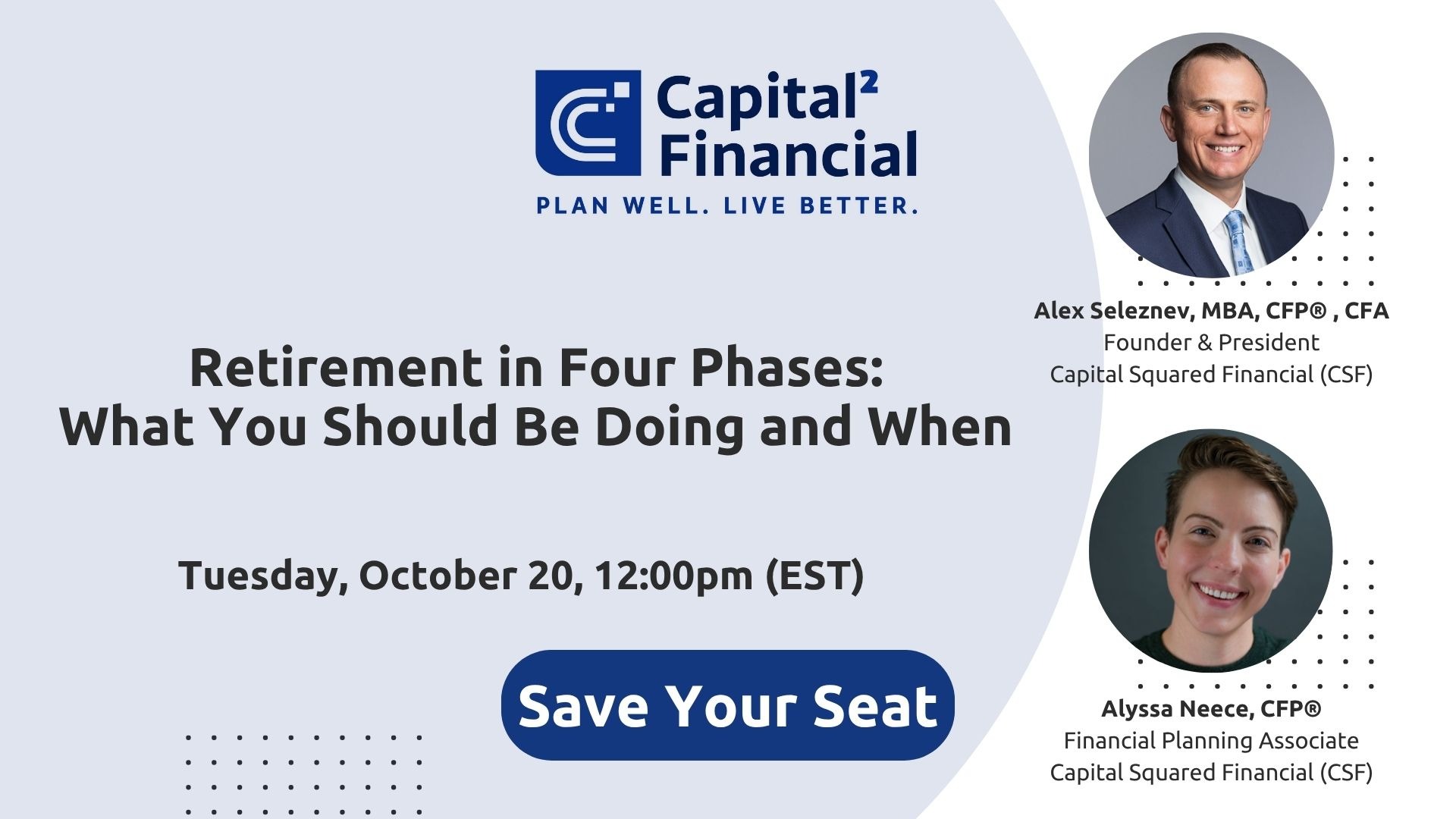
Retirement in Four Phases: What You Should Do and When
Tuesday, October 20, 12:00pm ET (Zoom Event)
Retirement isn't a single date on the calendar. It unfolds in stages, and each one comes with its own decisions. Knowing what to focus on, and when, can make the difference between reacting to changes and being ready for them.
Over the past few months, our newsletters have walked through the details of our firm’s “Retirement Checklist,” phase by phase. This webinar is the companion conversation to that checklist. It’ll be a chance to talk through it together, answer your questions, and share real client stories.
In this webinar, Alex Seleznev, MBA, CFP®, CFA and Alyssa Neece, CFP® will keep it conversational rather than lecture-style. We'll share stories from each of the four phases of retirement: Pre-Retirement, Early Retirement, Full Retirement, and the Golden Years.
Most of all, we want this webinar to reflect what's on your mind. Submit your questions when you register, and we'll build the conversation around them, with plenty of time for live Q&A as well.
Everyone who registers will receive a copy of the checklist and the recording afterward.
Save your seat by clicking the image above or clicking HERE.
PAST EVENTS
[Chevy Chase at Home] Leaving a Legacy: Tax-Smart Charitable Giving in 2026
Tuesday, September 15th, 1:00pm ET (Zoom Event)
If you missed our webinar, the recording is now available and I think you will find it useful.
I covered both easy to implement and more complex tax efficient gifting strategies.
As usual, I tried to keep it as simple and easy to understand as possible.
We had an incredible turnout for our webinar with Chevy Chase at Home with over 60 attendees and lots of good questions!
You can click the image above, or click HERE to watch on YouTube.
You can also download the slides HERE.
But for those of you who simply don't have the time, here is a brief overview of the most important points we covered.
Big picture idea
Giving the exact same gift can cost significantly less, net of taxes, depending on which account you draw from and how you give.
The main goal is that more of your money supports your favorite causes, charities or religious organizations.
So the point of this webinar is to highlight tax-efficient ways to give your donations and show your support.
Here is a quick summary of what we covered, starting with the simplest strategies and moving to the more advanced ones.
Cash donations
Donating cash is the simplest way to support everyday charitable causes.
For 2026, single filers can deduct up to $1,000 and married couples up to $2,000 even if they do not itemize deductions.
However, selling investments to raise cash for a gift can trigger unexpected capital gains taxes if not planned carefully.
Appreciated stock
Transferring appreciated stock directly to a charity eliminates potential capital gains tax on the growth.
You receive a tax deduction for the full fair market value of the stock without owing taxes on the gain (subject to the 30% adjusted gross income or AGI threshold).
If you want to maintain your investment position, you can donate the shares and immediately repurchase them at current market value.
Donor Advised Funds (DAF)
A Donor Advised Fund allows you to make a charitable contribution today, claim an immediate tax deduction and give the money out to charities over time.
This approach is ideal for bundling several years of giving into a single tax year to surpass itemization thresholds.
It also simplifies your record keeping by centralizing all donations in one easy to use account (so you don't have to write and keep track of personal checks anymore).
Qualified Charitable Distributions (QCD)
If you are age 70 1/2 or older, you can transfer funds directly from a traditional IRA to a qualified charity.
Once you reach your 73rd birthday and Required Minimum Distributions (RMDs) begin, these transfers count toward your RMD.
To say this differently, each dollar of QCD lowers the taxable portion of your RMD dollar for dollar.
This is often the most tax-efficient method for retirees to fulfill their annual giving goals.
Real estate
Gifting appreciated real estate can yield a substantial tax deduction and remove a large asset from your taxable estate.
This strategy requires advance planning because property transfers involve appraisals and legal paperwork.
In my experience, there are relatively few people who would benefit from transferring real estate for charitable purposes but I wanted to include it here to be comprehensive.
Bequests and beneficiary designations
Leaving gifts through a will or updating beneficiary designations lets you maintain full control of your assets during your lifetime.
This is a good choice if you want to gift significant assets to charities and make sure you have enough funds for your own retirement needs.
Naming a charity as the beneficiary of a Traditional IRA is especially effective because non-profits pay zero income tax when they receive retirement funds.
This strategy helps you transfer more tax efficient assets, such as Roth accounts or real estate, to your heirs.
Life insurance and charitable trusts
Naming a non-profit as a beneficiary of a life insurance policy allows you to create a large future impact without surrendering your policy and potentially generating a large tax bill.
For larger estates, charitable remainder or lead trusts (CRAT/CRUT) offer flexible ways to generate income, reduce estate taxes and support key causes.
These advanced strategies require coordination with your estate planning attorney and CPA.
Real life example
Barbara wanted to leave significant gifts to her alma mater and several local charities.
Her assets included $500,000 in a Traditional IRA, a Roth IRA, a brokerage account and her house.
Here is what we did.
She named the charities as beneficiaries of her Traditional IRA.
The charities receive the full $500,000 completely tax free because non-profits do not pay taxes when they receive retirement funds (or any other funds).
Her children inherit the Roth IRA, brokerage account and her house.
The Roth IRA passes to them tax free and the brokerage account and house receive a step-up in basis.
Now here is the important part.
If her children had inherited the Traditional IRA instead, they would have owed roughly $150,000 in taxes as they are in a higher tax bracket.
So it truly matters which assets go to whom.
In summary
There is much more in the webinar recording, including other real life examples. So definitely check it out if you want to hear more!
It goes without saying that everyone's situation is different, so no single strategy will work for everyone.
If this is something you are seriously considering, feel free to reach out and we can talk through what makes sense for you.
Chevy Chase at Home: Is Moving to a retirement community right for you?
Wednesday, May 20th, 12:00pm ET (Zoom Event)
Are you trying to decide if moving to a retirement community is the right choice for you?
Or perhaps you just want to understand what the term CCRC means and what options are potentially available to you?
I discussed this and many other relevant and timely questions in my latest webinar at Chevy Chase at Home.
(Special thanks to Susan and everyone at Chevy Chase at Home for organizing this amazing event!)
You can click the image above or click HERE to watch the recording.
It was so much fun and we had over 80 highly engaged participants!
For what it's worth, I really think you should check it out even if you are just exploring your options.
One thing to make clear as I received some feedback from a few of the webinar participants.
I truly believe that staying at home for as long as possible is the best choice for many people and certainly our clients.
So I'm not saying that retirement community transitions are the best choice for everyone but they can work very nicely for some if you plan your transition correctly.
Here are some of the key points we covered:
1.) Real cost comparisons from local communities
2.) Why in-home care can actually cost more than a CCRC
3.) Why a refundable buy-in is not an investment
4.) Real case studies of clients who transitioned to CCRCs
5.) The buy-in vs. rental model and which one fits which situation
6.) Practical tips for evaluating communities
I hope you enjoy the recording and learn something new!
Bitcoin in the Modern Portfolio
Tuesday, March 24th, 6.30pm - 8.00pm
For DC area bitcoin-curious, skeptical, or long-term holders, this discussion moderated by the non-profit Bitcoin District Initiative, is designed for an investment and retirement planning audience.
Bitcoin is currently down roughly 50% from its recent cycle high. Periods like this are often when thoughtful evaluation makes the most sense. Not from a FOMO mindset, but from a disciplined portfolio construction perspective.
Historically, measured allocations to bitcoin have improved risk-adjusted returns in diversified portfolios. That does not mean it belongs in every portfolio, or at every size. But the data is worth examining carefully.
In this session, we covered:
The basics: what bitcoin is and what it is not
Historical portfolio impact from adding bitcoin,
Volatility: how extreme is it really, and how should retirees think about it?
Correlation: when does it diversify, and when does it behave like risk-on tech?
Position sizing: what has been optimal historically?
Rebalancing: how discipline can materially impact outcomes
Where (if anywhere) bitcoin fits inside a retirement plan
This was not a promotional event. It was a clear-eyed, data-driven discussion about portfolio construction, risk management, and long-term planning with two experienced investment advisors.
[VIRTUAL] Home Transitions in Retirement: What You Need to Know Before You Move
Wednesday, March 4, at 12:00 p.m. (EST)
Alex Seleznev of Capital Squared Financial and Jan Brito of Compass hosted this webinar that included a real estate market update and focused on helping retirees and pre-retirees think through important housing decisions later in life.
The discussion covered the real costs of selling a home and explored when renting in retirement might make sense.
We also reviewed how future healthcare or accessibility needs should factor into housing choices.
Last but certainly not least, we discussed how different retirement community models, including CCRCs and their “buy-in” structures, should be evaluated.
We shared many real examples of how our clients made similar decisions. The webinar recording is full of practical ideas for you to consider. Check it out!
Key Takeaways from Alex
1.) Make sure you fully understand the costs and tax implications of selling your home. Failing to do so can result in a big headache at tax time!
2.) Renting in retirement, even though not the most common choice, can give you a lot of flexibility early in your retirement.
3.) If you truly decide to age in place, make sure you fully understand the financial and “hidden” costs of such a decision.
Key Takeaways From Jan
1.) Always consult a financial advisor before making plans to move, whether to a senior community or a smaller residence.
2.) Prior to making any improvements to your home in preparation for a sale, consult a realtor to be sure you are strategic and cognizant of the potential return on your investment. It's not uncommon to engage with a Realtor 1–2 years in advance of your move so that you have an advocate and advisor.
3.) In terms of the solvency of CCRCs, there are approximately 2,000 of them across the US. The number that have actually failed and gone bankrupt is about 1%. So it's not a common occurrence. But when touring communities, ask for their "disclosures" and check their bond ratings with the help of your financial advisor.
[VIRTUAL] Market Outlook: What Could Break the Markets in 2026?
Wednesday, January 28, at 12:00 p.m. (EST)
After a massive three-year rally, the markets have reached a critical “crossroads.”
With the market currently valued 65% higher than its historical average, there are two looming questions.
What could potentially break the momentum and where future gains might come from?
In Part 1, Alex walks through historical bull markets and how the past three years compare.
He also covers potential sources of market turbulence in 2026 and provides practical suggestions for investors to take advantage of what the year has in store for us.
In Part 2, Asi catches us up on the state of the markets and gives us further investment strategies to consider for the year ahead.
Key Takeaways for 2026
1.) The next market shock is just around the corner.
2.) You need to resist the urge to make emotional changes to your portfolio, even when it can be challenging for you to do so.
3.) To be successful, consider “calmer” markets as the time to prepare and market turbulence as an opportunity.
4.) Pro-growth policies in the U.S. may boost corporate earnings in 2026, but inflation and rising bond yields could create risks markets may be underestimating.
5.) Global tensions may be shifting long-term, creating risks many investors have not experienced before.
6.) Staying diversified and flexible is important as market volatility is likely to continue and is difficult to predict.
[VIRTUAL] 2025 Year-End Playbook: Smart Planning & Investing Moves
Wednesday, November 12 at 12:00 p.m. (EST)
What a year it’s been… from market surprises to shifting economic trends, 2025 has kept everyone on their toes.
So what comes next and how can you position yourself for success in the year ahead?
In this webinar, Alex Seleznev, MBA, CFP®, CFA, and Asi De Silva, CFA will share their top year-end financial planning, tax and investment strategies to help you make the most of 2025.
You will leave with clear, actionable insights to help you make smarter financial decisions before year-end.
[VIRTUAL] THREE COSTLY RETIREMENT AND ESTATE PLANNING MISTAKES
Thursday, October 23 at 12:00 p.m. (EST)
Planning for the next chapter of your life isn’t just about building your nest egg, it’s about protecting it.
A well-crafted retirement and estate plan can make the difference between a smooth transition and a stressful one.
Yet even the most thoughtful plans can go off track due to a few common and easily avoidable mistakes.
Presenters Alex S. Seleznev, MBA, CFP®, CFA of Capital Squared Financial and Megan Campbell of Willow Legal Group discuss the Top Three Costly Retirement and Estate Planning Mistakes and How to Fix Them.
You’ll learn practical strategies to strengthen your retirement and estate plans and hear real-world examples.
[VIRTUAL] Beyond the Panic: Investing with Clarity After Liberation Day
Tuesday, July 22 at 12:00 p.m. (EST)
Let’s be honest, the second quarter of the year was tough for many investors.
If you weren’t sure about what to do with your investments, you weren’t alone.
Investing when the market is turbulent isn’t easy and we want to congratulate those who made the most of the market in April.
The quarter had some historic lows but ended with a quick recovery.
So, what’s next?
Check out a practical discussion about the markets in our most recent webinar recording, called “Beyond the Panic: Investing with Clarity After Liberation Day.”
We’ll update you on the markets, share our thoughts on important events coming up in the second half of the year and talk about some smart ways to think about your investments.
You don’t want to miss it!
Kiplinger personal finance: Annual yieldfest article
Alex Seleznev, MBA, CFP®, CFA was interviewed for the fourth time for the Kiplinger Annual YieldFest article that seeks to identify the best income-oriented investment options.
Income-oriented investments are a cornerstone of Capital Squared’s signature Fortress Financial Plan approach.
We pay particular attention to this side of investing because it can be especially beneficial during periods of market turbulence.
Here is the LINK to the full article.
[VIRTUAL] opportunity within chaos
Wednesday, April 16, at 12:00 p.m. (EST)
When markets get rough, smart investors can find new ways to grow their wealth. But first, you need to protect what you have. Defense is key before taking calculated risks.
What Makes This Market Downturn Different?
⤷ Understand why this time might not be like past crises
How to Invest Wisely During Uncertainty
⤷ Discover where to put your money safely during market ups and downs
How Global Politics Affect Your Investments
⤷ Learn how geopolitical changes can impact your portfolio
We share practical insights to help you safeguard and grow your wealth, explained in clear and simple terms without the jargon.