


Written by Alex Seleznev, MBA, CFP®, CFA | Mar 20, 2024

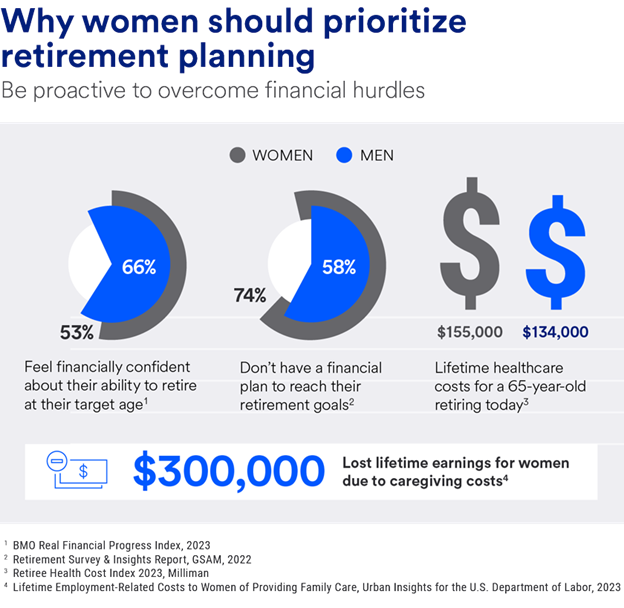
According to a special report by the BMO Real Financial Progress Index, only 53% of women feel financially confident about retiring at their target age.
This is compared to 66% of men who feel the same way.
Additionally, 74% of women surveyed mentioned they don't have a financial plan in place to reach their retirement goals, while this is the case for 58% of men.
Women encounter specific challenges when planning for retirement, but these challenges don’t have to disrupt your plans.
1.) Women have a longer life expectancy compared to men.
A woman aged 65 can expect to live another 21 years, which is 3 years longer than a man of the same age.
2.) Women earn less than men during their working years.
On average, women earn 21% less than men do.
3.) Women have fewer years of earned income.
On average, women spend 9 years out of the paid workforce than men. This is often due to their roles in caring for children and/or elderly parents.
4.) Women are more likely to work part-time jobs.
Women are nine times as likely as men to work part-time for caregiving purposes. Part-time workers are less likely to have access to benefits such as health insurance or retirement contributions. This results in women having less disposable income which often translates to lower retirement savings.
5.) Women face higher healthcare costs
Based on the Retiree Health Cost Index, a 65-year-old woman who retires today should anticipate healthcare expenses of approximately $155,000, in contrast to the $134,000 expected by a 65-year-old man.
So how can women be better prepared for retirement?
👉 Understand your retirement budget
Account for the realities of additional costs due to longer life expectancies.
Consider projecting retirement expenses until age 95 or even 100.
Adjust your budget to include an additional 10% to 20% for healthcare expenses.
👉 Prioritize investing and saving
Begin as soon as possible to take advantage of compound interest.
The good news is that women tend to hold onto their investments for longer periods, which helps achieve better rates of return in the long run.
A good starting point is to save 10% to 15% of your income for retirement.
👉 Protect your savings by having the right insurance mix
Women are more likely to require Long-Term Care (LTC) insurance.
Even if you choose to self-insure, it's essential to be conservative with your estimates.
👉 Establish a larger emergency reserve
We normally recommend maintaining 3 to 6 months' worth of regular expenses in reserves.
For women, these figures may need to be larger, around 6 to 9 months' worth of their regular expenses.
👉 Build a reliable income stream in retirement
Consider the following sources of income: Social Security, pension income, dividends, personal savings, and retirement account distributions.
It's crucial to have a clear distribution plan that takes into account longevity and additional healthcare needs during retirement.
Planning for retirement can pose unique challenges for women, but these obstacles don't need to derail your plans. By engaging in careful planning and preparation, you can achieve the retirement lifestyle you've always envisioned!