


Written by Asi de Silva CFA | April 4, 2025
As many of you know, the tariff announcement on Wednesday resulted in heightened market turbulence on the following trading day. As I finalize this note, the markets are on edge with expectations of retaliatory tariffs from other countries.
If you are a client of Capital Squared, please know that we are diligently keeping track of market conditions and will make adjustments in your portfolio when the time is right. We rebalanced our clients’ accounts at the end of 2024 and then again in January 2025, prior to the inauguration date. As a result, we are confident in our ability to navigate the markets and weather the storm.
I would like to remind you that, just as in any previous market crisis, it’s imperative to focus on your financial plan and resist the emotional response that often leads to suboptimal decisions. I’m here to help if you have any questions. Please simply send a reply at the bottom of this webpage or call (240-600-1678) if you’d like to discuss anything.
Below are our thoughts on the markets and what comes next. Please note this letter is not meant to be a comprehensive analysis of the current circumstances. We plan to announce a webinar where we will deep dive into the markets soon.
US Tariffs Have Risen to the Highest Level in Over a Century
The new administration is trying to reverse the unsustainable trade deficit and increase domestic manufacturing employment. Both are reasonable long-term or, at best, intermediate-term goals. Trying to do so by abruptly imposing high tariffs risks a global slowdown.
If you follow the markets and find yourself unable to connect the dots on the benefits of the current approach, you are by far not alone. The overwhelming consensus among prominent economists and financial analysts is critical of the President’s tariff policies, with few, if any, expressing confidence in their success.
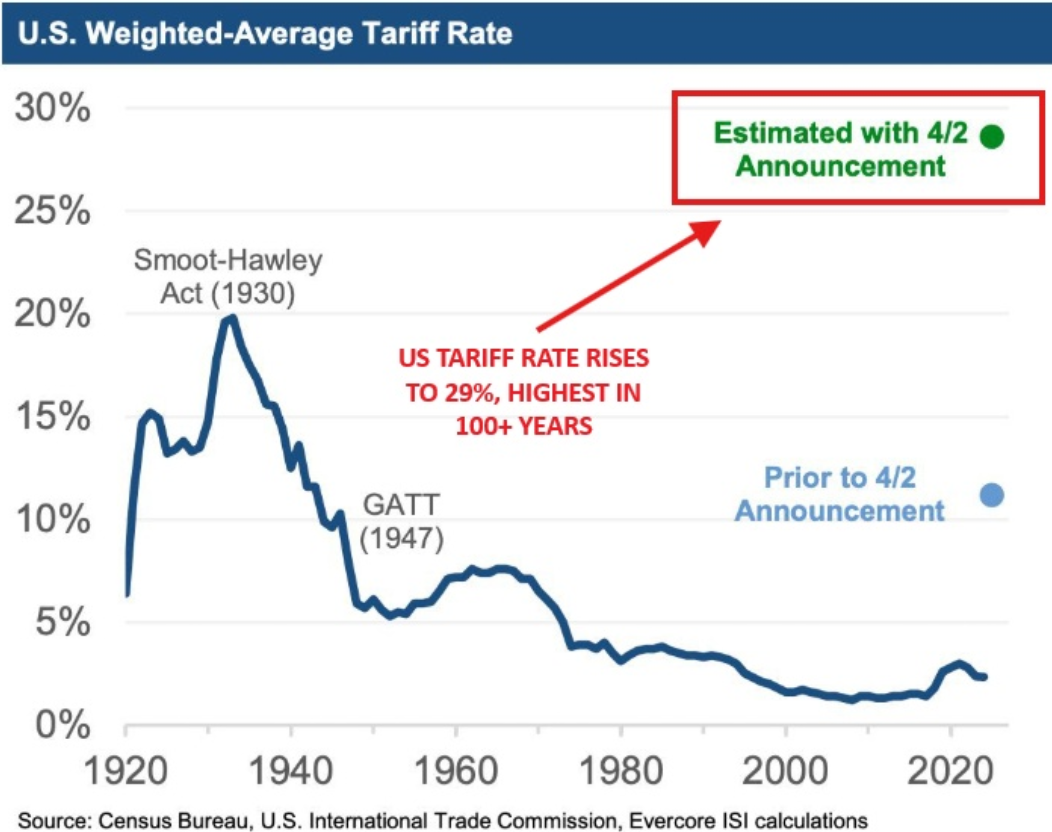
What happens with the economy if the current levels are in place for an extended period?
Most analysts believe that if the negotiations take less than two to three months, the U.S. and global economies will likely escape any severe consequences. If it takes longer, the U.S. could tip into stagflation, where inflation is too fast and growth stagnates.
Of course, all of this could swiftly change with a Truth Social post, but the markets don’t know when or if that might happen. This uncertainty is bad for businesses trying to make investment decisions and may push consumers to cut back on spending.
What are the possible outcomes at this time?
The risks are global. Even though we are hearing mixed signals from the new administration, the current level of tariffs is clearly unsustainable. There will be no winners if the trade war continues over any extended time period.
Negotiations are still the most likely outcome at this time. It remains uncertain how long it might take to come to a clear conclusion with our major trading partners. The chart below shows a world map color-coded by tariff levels.
 Source: www.reuters.com
What are the long-term risks?
Eroding trust is a significant long-term risk. In the world of international relations, trust is paramount. Once broken, it's incredibly difficult to rebuild. If the U.S. is seen as an unreliable partner, countries may seek to reduce their dependence on the U.S. dollar and the existing U.S.-centric financial system. Foreigners own $26 trillion of U.S. assets that they could liquidate due to lack of trust or because their beleaguered economies need the support.
Are there any safer places to hide?
Bonds proved to be a safe place to be this year. The Barclays Aggregate Bond Index is up +2.54% since the beginning of the year. Conservative and/or dividend-paying stocks are holding up relatively well and are down by -1.31% for the year. Gold has been rallying since the beginning of the year, +16.72%.
Overall, if you prepared your portfolio over the past few years or have a Fortress Financial Plan, you should be well prepared to withstand any challenges ahead.
What strategies are we considering at this time?
We need to have more clarity on the tariffs situation before we make any firm-wide portfolio adjustments. Many prominent tech stocks have declined 20–30% in less than two months. If you focus on the long-term fundamentals of these companies, you may find some of them rather attractive based on today’s valuations.
This is clearly not to imply that implementation of any such strategies will result in any quick gains. If you have a long-term view, consider exploring your options when others are fearful about the future. Once the dust settles, there is a possibility that international stocks will present attractive opportunities, but you need to be selective. As mentioned earlier, there will be no winners from any prolonged trade war. We have to be careful before we jump to any premature conclusions on what parts of the world will fare best when it all settles.
What should you be doing about all of this?
As Warren Buffett famously pronounced, “The stock market is a device for transferring money from the impatient to the patient.” These words have little meaning when the markets are rallying and the sky is the limit. When things become more challenging, many investors, specifically on the retail side, are quick to change their plans and alter their behavior. This can lead to serious long-term consequences and even destruction of your wealth.
So be vigilant and patient, however challenging it might be for you given the circumstances.