


Written by Alex Seleznev, MBA, CFP®, CFA | June 11, 2025

Each year, millions of people fall victim to different financial scams. Even worse, these scams become more creative and involved each year.
Unfortunately, older adults tend to be more susceptible to these scams and frequently targeted by cybercriminals. This is particularly concerning to me since many of our clients are older adults and most financial transitions now happen electronically.
Just last week, I received an email from one of our clients with a phishing message. Here is what it looks like.
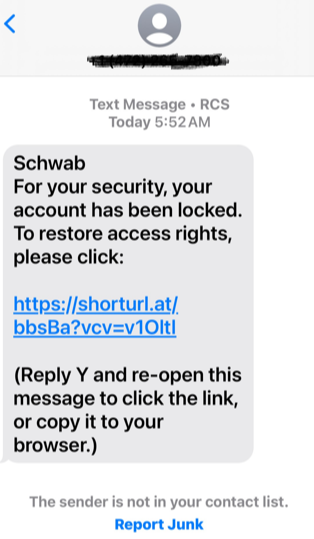
Fortunately for our client, she quickly recognized it as a phishing message and deleted it from her phone.
But what are other types of scams that you should be aware of?
1.) Phishing emails or texts.
As in the example above, the idea is to send a message that looks like it’s from your bank or some other online account. Even though many financial institutions do send messages to verify information, you should watch for red flags such as an urgent tone, strange links and even typos. Be very, very cautious if a message like this asks you to “verify” your personal or financial information.
2.) Tech Support Scams
Older adults are particularly susceptible to this scam as many do not feel entirely comfortable with the use of technology. As you browse the internet, a pop-up screen may appear telling you that your computer is infected with viruses. They will usually want you to call them to gain remote access to your computer and get your sensitive data. Please know that major tech providers such as Microsoft or Apple will not reach out to you unsolicited for tech support calls.
3.) Government and IRS Impersonation Scams
Each year, I personally receive a good dozen of these calls. Some do sound convincing and even threatening if you do not take a certain “action” such as paying your fake tax bill. Government agencies such as the IRS will never call you demanding payment or other information. Most of their communication is done by mail or via secured government websites.
4.) Relative Scams
Here is how it works. Using artificial intelligence, you may receive a phone call from your “son” or “nephew” who is in trouble. They will sound just like your relative (scary!) and urgently ask you to send them money.
What can you possibly do about it?
Don’t panic if you receive a call like this. Dial your relative or someone close to them to make sure they are fine.
5.) Investment Scams
If you ever search the internet for investment information, I have no doubt you will eventually see one of these scams. These are usually advertisements that guarantee certain returns or offer exceptional results if you just follow their “proven strategy.” If it sounds too good to be true, then it’s probably exactly that. There is just no way someone can guarantee a 50% return to you year over year, regardless of how good it sounds.
6.) Home Repair Scams
This is perhaps one of the more basic scams and tends to result in relatively small losses but should still be avoided. A good-looking young man or woman may come to your house claiming they are just in your neighborhood and offering roof repairs for a very low cost. Once they collect a small upfront payment to put you on the “list,” they simply disappear and you never hear from them again.
7.) Romance Scams
These are perhaps some of the most elaborate and dangerous scams and tend to target older adults. When people feel lonely and housebound, they go online looking for company and conversation. Very soon, they find an interesting and talkative person who takes the time to build a certain level of emotional attachment to them. This online “dating” can last for months before the perpetrator asks for any money.
At first, they ask for small cash transfers to help them with small tasks or purchases. As this fake “relationship” continues, the con artist will ask for more and more. Unfortunately, there are stories of older adults getting scammed out of hundreds of thousands of their retirement funds.
What is even more concerning to someone like myself is that some of the victims worked with financial advisors who took no action to prevent these scams.
Staying safe online doesn’t have to be stressful. Just remember to pause, double-check and trust your instincts.
If something feels off, reach out to a friend or family member for a second opinion.