


Written by Asi de Silva CFA | October 29, 2025

Many investors face a significant challenge: how to redeploy capital from a profitable investment without immediately triggering a large tax bill on their capital gains.
Tax deferral strategies are powerful tools that can allow you to keep more of your money working for longer, potentially leading to greater wealth accumulation over time.
Two prominent strategies for deferring capital gains taxes are investing in a Qualified Opportunity Zone (QOZ) and using a 1031 exchange with a Delaware Statutory Trust (DST).
QOZ: A Flexible Option for all Capital Gains
OQZs were established under the Trump 1.0 tax act in 2017. The original rules allowed tax deferral until December 2026, which is now near. However, the bigger benefit is from the tax-free gain on the investment, as explained below.
The recently passed OBBB made QOZs permanent, and the new rules will start with QOZ investment made after 1 January, 2027. This includes a rolling 5-year tax deferral, a 10% step-up in basis for the deferred amount after 5 years.
How It Works
Generate a Capital Gain: You must first have a capital gain from any source - the sale of stock, real estate, or any other asset.
Invest the Gain: You have 180 days from the date of the sale to invest the capital gains (not the full sale proceeds) into a Qualified Opportunity Fund (QOF). A QOF is a private investment vehicle that must hold at least 90% of its assets in a QOZ.
Deferral and Reduction: You can defer paying the tax on the original capital gain until the end of 2026. Starting in 2027, If you hold the QOF investment for at least five years, the original deferred gain is reduced by 10%.
Tax-Free Growth: This is the most powerful benefit. If you hold the QOF investment for 10 years or more, any appreciation in the value of your QOF investment is completely tax-free at sale.
The example below is what I highlighted recently when a friend of mine asked if a QOZ was an appropriate strategy to invest gains from selling his beach house.

Assumptions: $1m initial gain, 10% IRR, 10-year holding period, 30% capital gains tax (Federal+NIIT+State).
Note: We have used simple round numbers for illustrative purposes. Possible Interim cashflows have been ignored to simplify the illustration.
Key Characteristics of QOZs
Flexibility of Source: The original capital gain can come from the sale of any asset, not just real estate.
No "Like-Kind" Requirement: Unlike a 1031 exchange, you don't have to reinvest into a "like-kind" asset.
Set Timeline: The tax benefits are tied to specific deadlines. The current deferral period ends in 2026, but starting 2027, the capital gains taxes can be deferred for 5 years. The most valuable tax break is the tax-free appreciation, which requires a 10-year hold period.
1031 Exchange with DSTs: An Establish Standard for Real Estate
The 1031 exchange is a provision that allows you to defer capital gains taxes on the sale of investment property. When you sell one property, you can use the proceeds to buy another "like-kind" property, thereby deferring the tax liability.
Many real estate investors are aware of buying another like property in a 1031 exchange. But, managing real estate in retirement may not be for everyone.
That’s where a Delaware Statutory Trust (DST) becomes a popular structure that allows you to retain real estate exposure, defer taxes and avoid managing the real estate.
How It Works
Sell an Investment Property: You sell an investment property and have capital gains. Need to reinvest entire net proceeds of sale
Identify and Purchase a Replacement Property: You must identify potential replacement properties within 45 days of the sale and acquire one of them within 180 days.
Use a DST: Instead of purchasing a single property on your own, you can invest in a DST. This allows you to own a fractional interest in a portfolio of institutional-grade properties (e.g., apartments, warehouses) managed by professionals. This can be an ideal solution for clients who:
- Want to diversify their real estate holdings.
- Are looking for a more passive investment without the management responsibilities of direct ownership.
- Struggle to find and acquire a replacement property within the strict 1031 exchange deadlines.
Deferral and Continual Rollover: As long as you continue to exchange "like-kind" properties or DSTs, you can defer the capital gains tax indefinitely. When your estates passes to your heirs they receive a "stepped-up" cost basis, and the deferred capital gains are eliminated completely.
Key Characteristics of 1031 Exchange DSTs
"Like-Kind" Requirement: The exchange must be between properties held for investment or business use.
Strict Deadlines: The 45- and 180-day deadlines are non-negotiable.
Passive Ownership: DSTs allow for passive ownership, as a professional fund investor handles all management responsibilities.
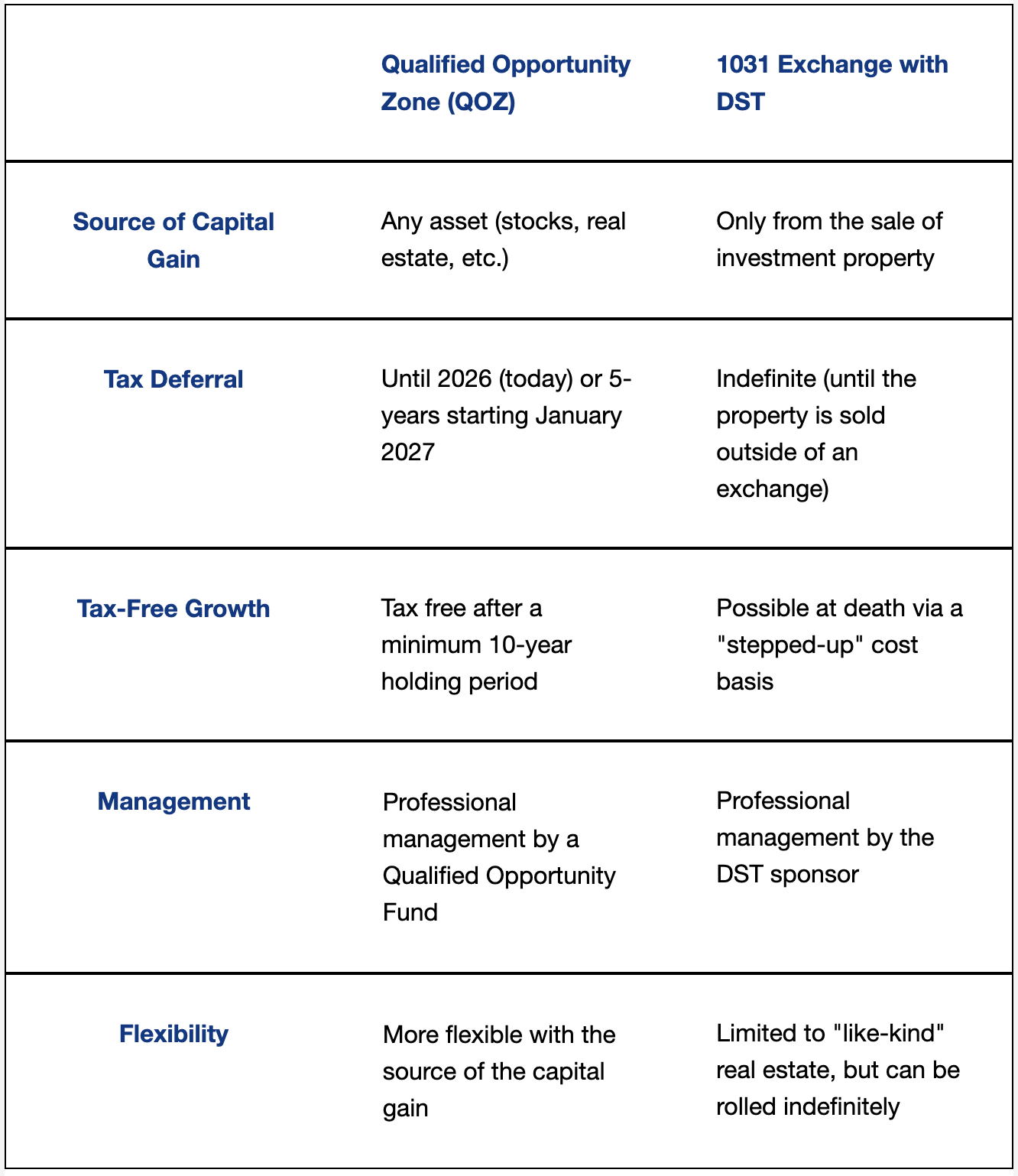
Both strategies have their appeal. For QOZ, the investment gains become free of capital gains after a decade, akin to a Roth IRA. This is a unique feature that few other solutions can match. However, gains after that initial decade (could be held for longer) can’t be rolled into another QOZ.
In contrast, 1031 exchange DSTs allow for rollovers for decades and a step-up in basis when passed along to heirs.
Each solution has its place based on client circumstances. That’s where we focus our discussion with clients.
With both QOZs and 1031 exchanges, it is crucial to start the planning process well in advance of the sale. Performing due diligence on prospective QOZ funds and 1031 exchange DSTs takes many hours, which makes advance planning important.