


Written by Asi de Silva CFA | December 17, 2025
In recent weeks, the volatility in Big Tech has highlighted a core tension in today’s market. Large scale capital investment may be fueling growth, but is it creating value?
This week, Verdad Advisers published an excellent study that looks at rising capital Spending (capex) and stock performance.
They conclude that share prices of companies with rising capex underperform those with lower capex/high free cashflow.
You can read the entire research note here.
The capex boom and why it matters
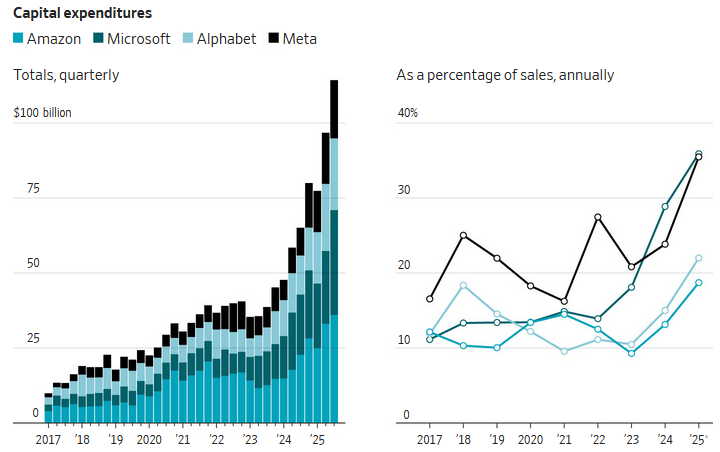
Big Tech capex is exploding. These firms are now building data centers, buying servers and infrastructure, and committing substantial spending in the near term.
These companies are swiftly moving away from their asset light, high return operating model of the past. Given this trend, whether share should continue to command a premium valuations remains an open debate.
Here are a few charts that illustrate the capex surge.
Source: WSJ
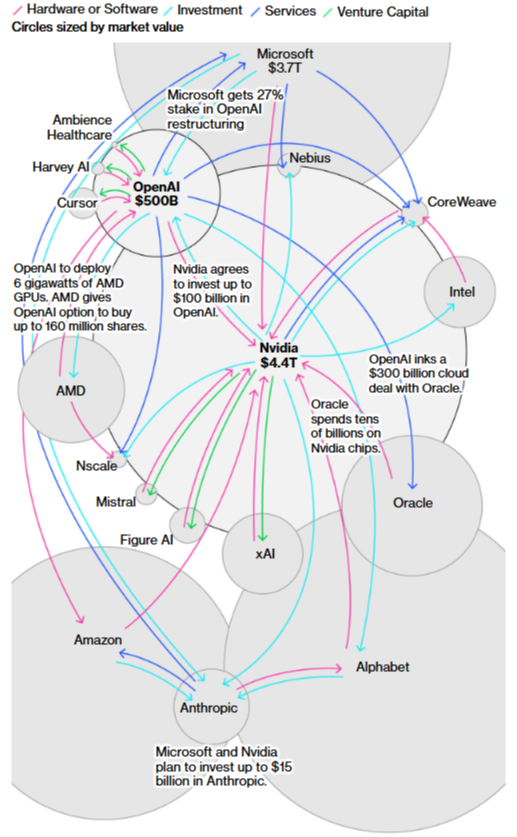
The circular financing arrangements (see below) with Nvidia at the center of that hub raises additional red flags.
Source: Bloomberg
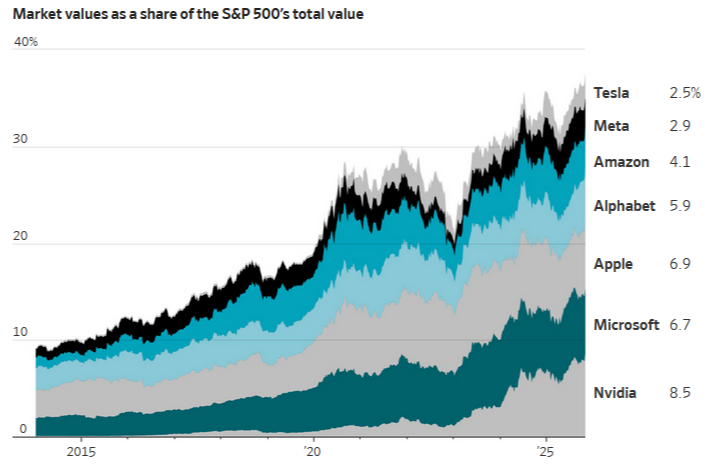
The current AI excitement has led to falling diversification With the Mag7 stocks accounting for over 35% weight in the S&P 500 Index.
Source: WSJ
Growth Does Not Equal Return
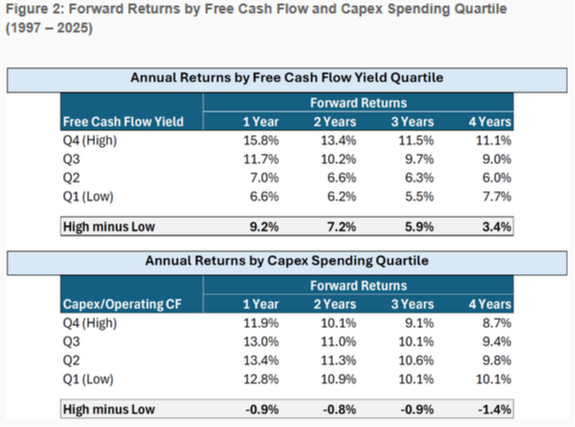
Verdad’s research shows high free cash flow / lower capex spending companies’ shares performed better as the two tables below illustrate.
Source: Verdad
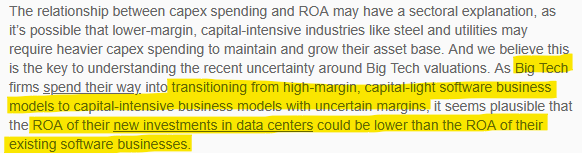
The study did find that higher capex resulted in higher future earnings, but that did not translate to better share price performance.
Companies with high free cash flow yield today, which many investors view as quality firms, have produced more modest earnings growth, but have delivered better investment performance over time.
This is how Verdad reconciles the paradox of higher earnings, but weaker returns. The highlights are mine.
Source: Verdad
Do the correlations of the past hold in the future?
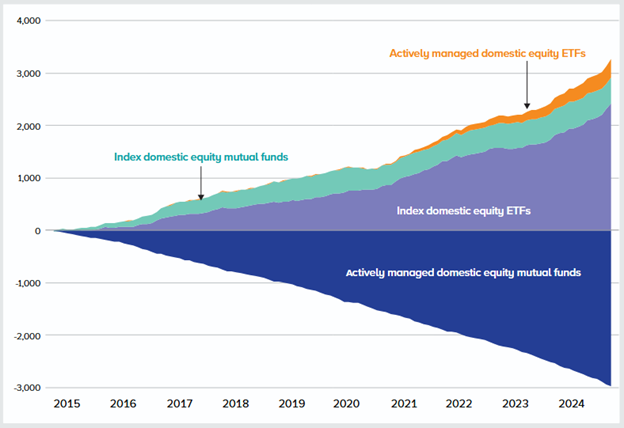
With the dominance of passive investing flows, the future could well diverge from the correlations from the 1997 to 2025 study period. Passive investing mechanically plows savings into indices without considering fundamentals like profits, returns, or valuations. There has been a regime shift in investor flows moving away from active mutual funds to passive ETFs, as the chart below shows.
Investors Are Leaving Active Stock Mutual Funds For Passive Strategies
(Cumulative flows into domestic stocks in billions of dollars)
Source: Investment Company Institute 2025 Factbook
If this trend continues, future returns could diverge not only from historical patterns but also from fundamentals like profitability and valuation. That’s a more worrying subject for another time.
Bottom line:
The capex boom among the Mag 7 may help build the next generation of AI, cloud computing, and data infrastructure.
Verdad’s research, however, reminds us that higher investment does not automatically lead to higher returns.
Evidence continues to show that companies with strong free cash flow and high asset productivity provide more dependable performance than high growth, high capex strategies.
At CSF, we continuously research and incorporate leading insights into portfolio construction.
Verdad’s study adds to the analytical mosaic we incorporate to deliver the portfolio outcomes clients desire.