


Written by Alex Seleznev, MBA, CFP®, CFA, and Alyssa Neece, CFP® | September 30, 2026

As we slowly but surely get closer to the end of the year, I wanted to share my brief thoughts on the markets and what we have been watching here at Capital Squared.
To be clear, this is not meant to be a full market analysis. We will have a separate newsletter, or to be specific a recorded video, on the issue later.
I mostly wanted to share my answers to some of the top investment questions from clients and some anticipated questions as we get close to midterm elections.
As always, all of it in plain English so you can understand and hopefully feel more comfortable with where we are in the markets today.
I will start with the topic that is heavily discussed by both the general public and the investment community: midterm elections.
And no, I will not get into the analysis of who will likely prevail and how the Senate and the House may potentially change.
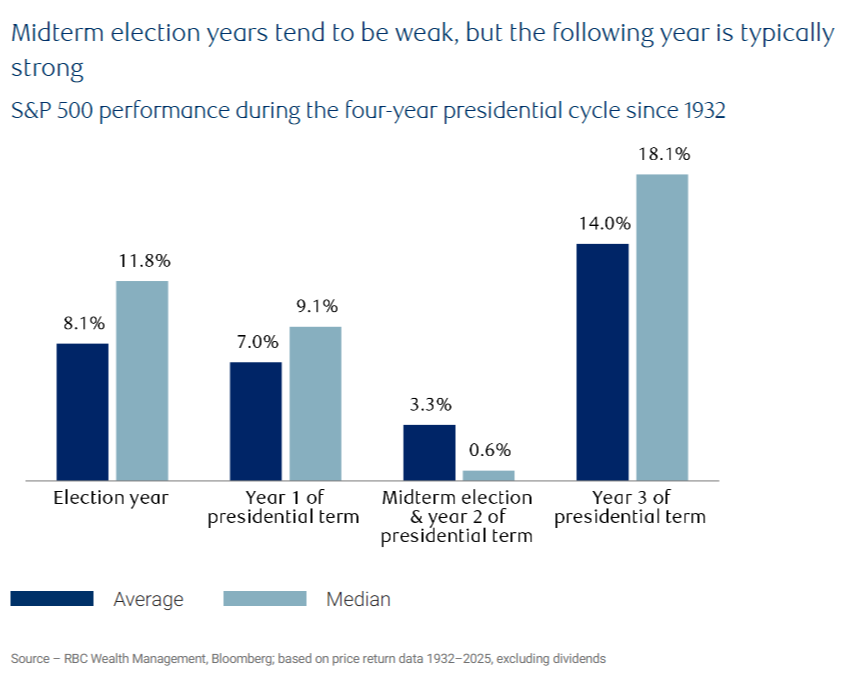
I will just say that historically speaking, and as you can see on the graph below, midterm election years tend to be weak but the following year is typically strong.
In terms of potential market turbulence, most of it usually happens 2 to 3 weeks leading up to the election. This is logical because the markets are quickly adjusting to the potential outcomes of the election.
Post election, the markets often bounce back, assuming we see market turbulence of more than a few percentage points.
With my brief comments on midterms out of the way, here are a few other questions we discussed with clients over the past couple of weeks.
What's happening in the bond market and why are yields so high?
For those of you who haven't been following the bond market too closely, the yields on the 10-year treasury spiked to over 5% over the past several weeks.
This is the highest yield we have seen since 2007.
Higher oil prices, government spending, stronger economic growth and companies borrowing to build AI are all pushing inflation up, which in turn pushes yields higher.
Here is the simple version of why this matters.
Higher yields usually mean the market expects more inflation. That often leads to higher interest rates, which tends to slow the economy down.
This is why bond yields and stock market volatility tend to move together.
Here at Capital Squared, we have been proactively adjusting our bond allocations throughout the year to keep maturities on the shorter end.
So this is not something we are suddenly reacting to.
From your perspective as an investor, maintaining your bond allocation in bonds with short maturities, so maturing in 1 to 3 years, is a prudent move.
For those who seek higher yields and have a longer term horizon, considering intermediate term bonds with maturities between 4 and 7 years is one option as yields can be appealing.
What about the stock market overall?
Even though the markets have mostly moved sideways over the past several months, the S&P 500 index remains close to an all time high.
From our perspective, even given the concerns I've shared earlier, there are relatively few bargains remaining at this point.
If we experience more market turbulence leading up to the midterms, we would need to see a significant decline to consider buying stocks at lower prices.
Just to give you an example, a 5 to 7% decline from the current level is not likely to be enticing enough in year four of the current market expansion.
How dangerous is AI and should it be regulated?
This is one of the most common questions I get right now. So I wanted to address it even though a few paragraphs won't do it justice.
The short version is that there is a healthy debate happening and that is usually a good sign.
Some of the leading AI developers have called for more oversight.
Others, including the President and several CEOs of major semiconductor companies, argue that heavy regulation would slow progress unnecessarily.
From an investment perspective, reasonable regulation would likely be a positive for the industry.
Clear rules tend to increase adoption because businesses and consumers feel more confident using the technology.
The more relevant question for investors is valuation.
A significant amount of capital is being invested in AI infrastructure right now and the market is pricing in very high expectations for what these companies will eventually earn.
That doesn't mean those expectations are necessarily wrong. It simply means we pay close attention to how much we are paying for that growth.
This is, of course, another reason to keep your portfolio diversified instead of focusing on just one sector or industry.
With the questions and answers out of the way, I wanted to focus a bit on other things that are important to keep in mind.
And specifically…
Focus on the big picture
It is easy to get caught up in the daily noise coming from financial media.
When you zoom in too closely, every dip looks like a cliff.
When you zoom out to a decade or more, those same dips often look like minor ripples.
Remind yourself why you invested in the first place. Reviewing your overall financial plan is a good choice too.
Most long term goals, such as planning for a comfortable retirement, are not likely to be impacted by near term events as long as you are managing them correctly.
Remember that the market does not need to be up today for your plan to succeed ten years from now.
Control what you can
You cannot control interest rates, geopolitical events or essentially anything that has to do with the markets.
Realizing this fact can be a relief on its own.
Instead, redirect that energy toward the factors within your reach.
You can control your asset allocation.
You have a choice of how much you keep in your emergency reserves.
You have control over how much you save each period to achieve your goals.
Most importantly, in times of market turbulence, you have control over what you do and what you don't do. This part cannot be overstated.
Taking advantage of market turbulence
Over the years of managing investment portfolios, I’ve trained myself to become more skeptical about the markets as they continue to go up.
I also tend to see more opportunity when we see market turbulence.
Make no mistake, this is not easy even for professional portfolio managers but it can be done.
I would rather not go into much detail here, but if or when the markets are down, try to see it as an opportunity.
It doesn't mean that you necessarily need to act, but at least try to see market turbulence as your friend and not as your enemy.
Write it down and sleep on it
So let's say you are about to make a decision that you are not sure about.
A part of you thinks or even knows that it's not going to be a good one (such as selling stocks when the markets are down).
When you feel like making a big decision very quickly, take a pause before you act.
Write down the decision you want to make on a piece of paper. And write down specifically why you want to make this decision.
Set it aside for a day and tell yourself you'll revisit the decision after a good night of sleep.
I promise you, many erratic decisions that can be costly and detrimental to your plan can be avoided using this strategy.
Practice strategic silence
In an era of 24-hour news cycles and constant smartphone notifications, we are bombarded with financial opinions.
Many of these sources thrive on sensationalism because fear drives clicks.
If your portfolio is causing you distress, it might be time to turn off the alerts.
Checking your accounts daily rarely leads to better outcomes.
It usually just leads to more anxiety.
Allow yourself to step away from the screen and focus on your life outside of your finances.
What does all of this mean to you?
You do not have to manage all of this alone.
A major part of what I do for our clients is provide a steady perspective.
If you find yourself confused about the markets or tempted to make a drastic change to your strategy, let's have a conversation first.
Often simply saying your concerns out loud and reviewing your original plan is enough to bring the clarity you need to stay invested.
Remember, investing is a marathon, not a sprint.
The finish line is still there, even if the path can feel a bit rocky every so often.